
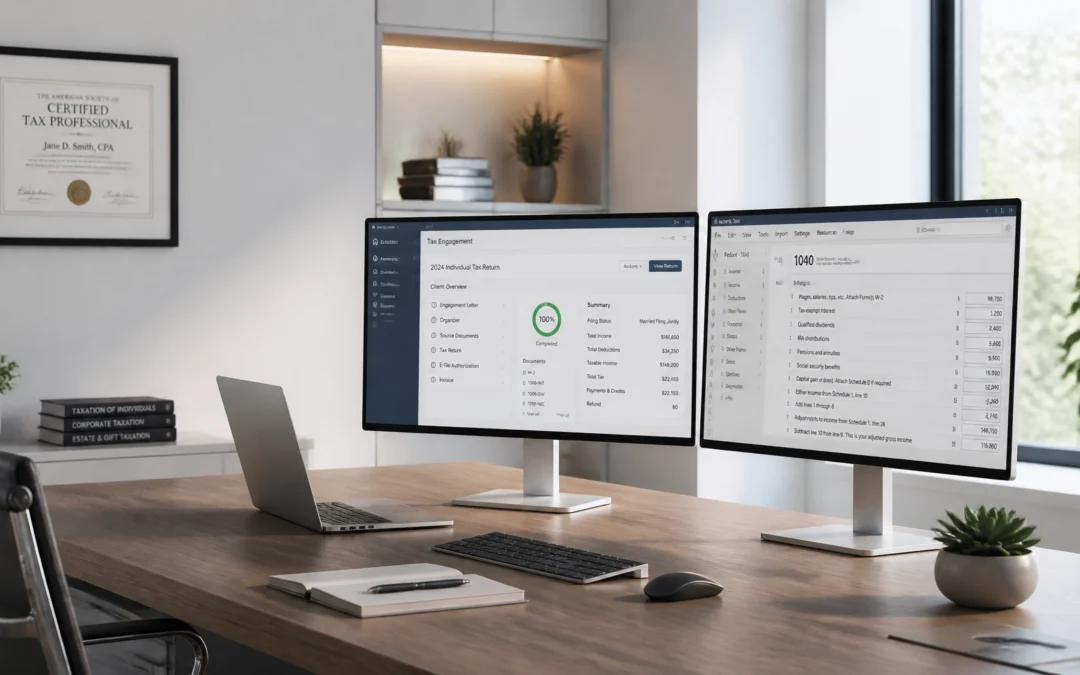
Scaling a tax preparation business from a solo operation to a multi-person firm requires transitioning from personal effort to a repeatable framework. Without a structured Electronic Return Originator (ERO) operations model, growth leads to increased error rates, IRS compliance risks, and service delays.
This framework outlines the essential pillars of a scalable ERO operation.
1. Structural Compliance and EFIN Management
The foundation of a professional tax firm is the Electronic Filing Identification Number (EFIN). An ERO must maintain strict control over this credential to prevent unauthorized usage and ensure IRS e-file program integrity.
Core Requirements:
- EFIN Security: Only the authorized e-file provider should have administrative access to the EFIN settings within the software.
- PTIN Management: Every individual preparing or assisting in the preparation of returns must have a current Preparer Tax Identification Number (PTIN).
- Suitability Checks: The IRS conducts suitability checks on all EFIN applicants. Maintaining a clean professional record is a prerequisite for scaling.
TIG Tax Pros provides comprehensive ERO services to streamline these electronic filing processes, ensuring firms stay compliant with Publication 3112 guidelines.
2. Standardized Service Delivery Workflow
To scale volume without increasing errors, every return must follow an identical path. A standardized workflow removes the need for individual preparer decision-making on administrative tasks.

The Seven-Step Process:
- Intake & Onboarding: Collect government-issued identification and basic taxpayer data through a secure digital portal.
- Document Retrieval: Utilize a standardized checklist for various taxpayer profiles (e.g., Schedule C, Rental, Multi-State).
- Data Entry: Junior preparers or administrative staff enter data into the software based on the gathered documents.
- Technical Review: A senior preparer or the ERO reviews the return for accuracy, tax law application, and due diligence compliance.
- Authorization: Obtain signatures on Form 8879 and engagement letters.
- Transmission: The ERO transmits the return under the firm’s EFIN.
- Acknowledgment Monitoring: Track acceptance or rejection codes daily to ensure 100% filing success.
3. Tiered Human Capital and Training
Growth is limited by the capacity of the ERO. Scaling requires delegating tasks to a tiered team structure.
- Administrators: Manage scheduling, document collection, and final signature tracking.
- Junior Preparers: Handle simple 1040 returns and initial data entry.
- Senior Reviewers: Responsible for complex tax issues and quality control.
Training is the primary lever for maintaining quality in a tiered model. TIG Tax Pros offers expert tax preparation courses for both beginners and seasoned professionals. These programs ensure that every team member operates with the same technical knowledge and procedural standards.
4. Information Security and the Safeguards Rule
The Federal Trade Commission (FTC) Safeguards Rule requires tax professionals to implement a written information security plan. A scalable operation must treat data security as a functional requirement rather than an afterthought.

Security Protocol Checklist:
- Multi-Factor Authentication (MFA): Mandatory for all tax software, email, and cloud storage access.
- Encryption: Data at rest and in transit must be encrypted using industry-standard protocols.
- Restricted Access: Implement "least privilege" access, where staff only see the data required for their specific role.
- Secure Disposal: Digital and physical records must be destroyed according to IRS retention and disposal guidelines.
5. Leverage via Service Bureau Support
For tax professionals who do not yet have an EFIN or those looking to expand into a multi-office network, the Service Bureau model provides immediate infrastructure.
TIG Tax Pros offers service bureau support that allows professionals to operate under an established ERO umbrella. This allows the business owner to focus on client acquisition and preparation while the bureau handles the backend transmission and software management.

Benefits of Service Bureau Integration:
- Reduced Overhead: Eliminates the need for separate EFIN applications and independent software contracts.
- Operational Guidance: Access to expert support for complex filing scenarios.
- Rapid Deployment: Ability to open new locations or hire remote preparers quickly using a centralized system.
Summary of Framework Implementation
| Phase | Focus Area | Objective |
|---|---|---|
| Phase 1 | Compliance | Secure EFIN and PTINs; finalize written security plan. |
| Phase 2 | Training | Enroll staff in TIG Tax Pros courses. |
| Phase 3 | Workflow | Implement standardized checklists for intake and review. |
| Phase 4 | Scale | Utilize Service Bureau support for multi-location expansion. |
Establishing these operational controls is the only way to grow a tax practice without compromising quality or inviting IRS scrutiny. For further details on professional development and ERO infrastructure, visit TIG Tax Pros.