
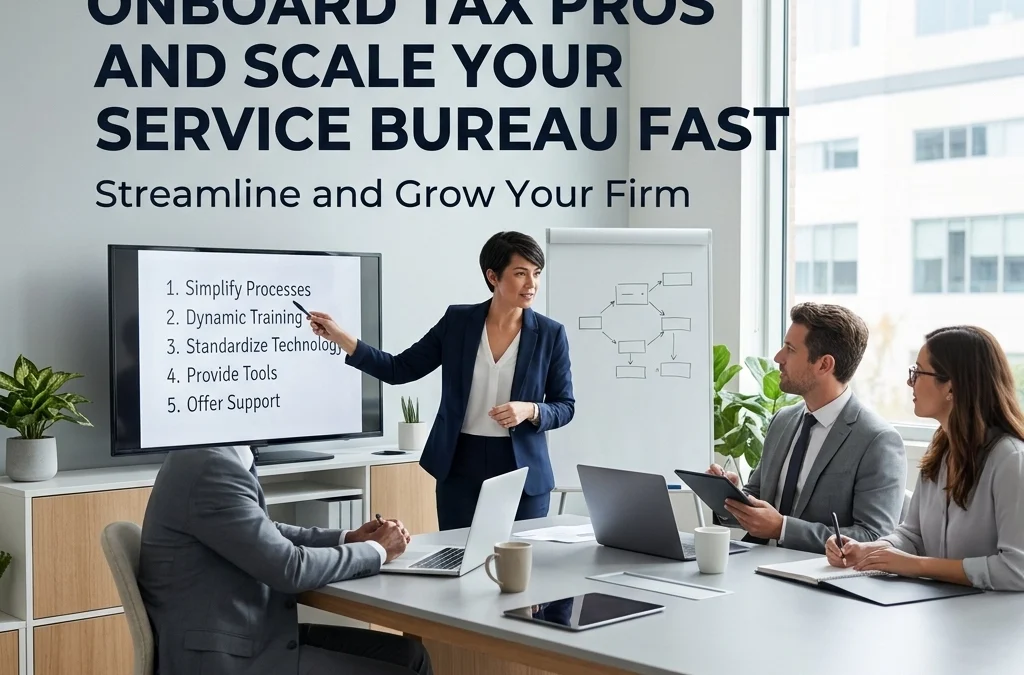
SEO Title: 5 Steps to Onboard Tax Pros and Scale Your Service Bureau Fast
Slug: /onboard-tax-pros-scale-service-bureau/
Excerpt: Learn the five essential steps to efficiently onboard tax professionals, manage ERO operations, and scale your service bureau for long-term growth.
Tags: Service Bureau, Tax Professional Onboarding, ERO Operations, Tax Software, Business Scaling, TIG Tax Pros
Scaling a tax service bureau requires a transition from individual tax preparation to high-level organizational management. For Electronic Return Originators (EROs) and tax business owners, growth is dependent on the ability to recruit, train, and support a network of tax professionals. Efficiency in these processes determines the profit margins of the bureau.
The following five steps outline the technical and operational requirements to onboard tax professionals and scale a service bureau effectively.
1. Secure Required Infrastructure and Compliance
The foundation of a service bureau is built on compliance and technical infrastructure. Before onboarding partners, the bureau must have all federal and state credentials in place.
Federal and State Credentials
Every service bureau must possess a valid Electronic Filing Identification Number (EFIN). As an ERO, you are responsible for ensuring that the professionals you onboard also comply with IRS regulations. In Georgia, specifically, tax professionals must stay updated with the Georgia Department of Revenue’s requirements for electronic filing and preparer conduct. Proper due diligence during the initial phase prevents service interruptions during the peak tax season.
Software Selection
Selecting the right tax software is a critical infrastructure decision. The software must support multi-office management and provide the bureau owner with visibility into all sub-offices. Options like Essential Tax Software or Unlimited Tax Software allow for varying levels of scale depending on the number of returns processed and the number of locations managed. White-labeling software provides the opportunity to brand the platform, which increases the perceived value of the service bureau to prospective partners.

2. Standardize Training and Support Systems
A service bureau cannot scale if the owner is required to answer basic technical questions for every sub-office. Standardization of training is necessary to move the burden of support from the individual to a system.
Comprehensive Software Training
Onboarding must include a structured software training module. This should cover:
- Client intake and data entry.
- Handling complex forms and schedules.
- Error diagnostic resolution.
- Remote signature capture and document storage.
Operational Support
Beyond tax theory, partners need to understand the operations of the bureau. This includes the internal workflow for return review, communication protocols, and how to utilize ERO services to succeed. Providing a digital handbook or a series of instructional videos reduces the time spent on repetitive administrative tasks.
3. Implement Efficient Onboarding Workflows
The onboarding process should be a pipeline that moves a prospect from an initial agreement to a fully operational tax office. Inefficiencies in this pipeline lead to lost revenue and partner frustration.
The Recruitment Funnel
Recruitment of tax professionals should target different levels of experience. The bureau should offer packages for experienced EROs looking for better software rates and for new preparers who need comprehensive mentorship. Utilizing tools like the PS3 recruitment system can help in identifying and signing new partners consistently.
Bank Enrollment and Fee Setup
A critical step in onboarding is the bank enrollment process. Service bureaus generate revenue through add-on fees, service bureau fees, and transmission fees. During onboarding, you must assist partners in:
- Selecting a banking partner (e.g., Santa Barbara TPG, Refundo, or EPS).
- Setting up their fee schedule within the tax software.
- Completing the compliance requirements for bank product offerings.

4. Manage ERO Operations and Compliance
Once partners are onboarded, the focus shifts to operational oversight. A service bureau owner acts as a consultant and a compliance officer for their network.
Quality Control and Audit Protection
Maintaining a low rejection rate with the IRS is vital for the longevity of the EFIN. Service bureaus should implement a review process for sub-offices, particularly those run by newer preparers. Integrating audit protection into every return not only provides a better product for the end consumer but also protects the service bureau and its partners from the fallout of IRS inquiries.
Performance Monitoring
The bureau owner should use the reporting tools within the tax software to monitor the volume and accuracy of returns across all locations. In Georgia, staying compliant with state-level mandates requires regular check-ins on how state returns are being processed and filed. Real-time data allows the bureau to allocate support resources where they are most needed.

5. Diversify and Scale Revenue Streams
Scaling a service bureau involves moving beyond seasonal tax prep fees. To grow fast, the business must generate year-round revenue and offer high-value additions to its partners.
Value-Added Services
Offering ancillary services such as bookkeeping, payroll, and SaaS products allows partners to increase their revenue per client. When the partners make more money, the service bureau becomes more stable and attractive to future recruits.
Expanding the Network
Growth is achieved by adding more locations and more preparers. This requires a shift in mindset from being a tax preparer to being a business developer. Service bureau owners should focus on building a brand that stands for reliability and technical excellence. Resources like the TIG Tax Pros blog provide ongoing updates and quick tips to assist in this expansion.

Retention Strategies
Retaining high-performing tax professionals is more cost-effective than recruiting new ones. Long-term retention is built on:
- Competitive fee splits.
- Superior technical support.
- Access to the latest tax preparer certification information.
- Reliable software performance during the peak of tax season.
Conclusion
Scaling a service bureau is a process of systematic onboarding and operational discipline. By securing the right infrastructure, standardizing training, and implementing efficient workflows, EROs can build a scalable and profitable tax business. Use the tools and services available at TIG Tax Pros to streamline your operations and ensure your bureau is prepared for the next tax cycle. For those ready to begin the transition, the option to become a TIG Tax Pro provides a direct path to the necessary software and support.