
SEO Title: Service Bureau Infrastructure Guide for Tax Professionals
Slug: service-bureau-infrastructure-guide-tax-pros
Excerpt: Learn how to build and scale your tax service bureau infrastructure. This guide covers technical requirements, ERO operations, and growth strategies for pros.
Tags: Service Bureau, Tax Technology, ERO Operations, Tax Business Growth, IRS Compliance, California Tax Law
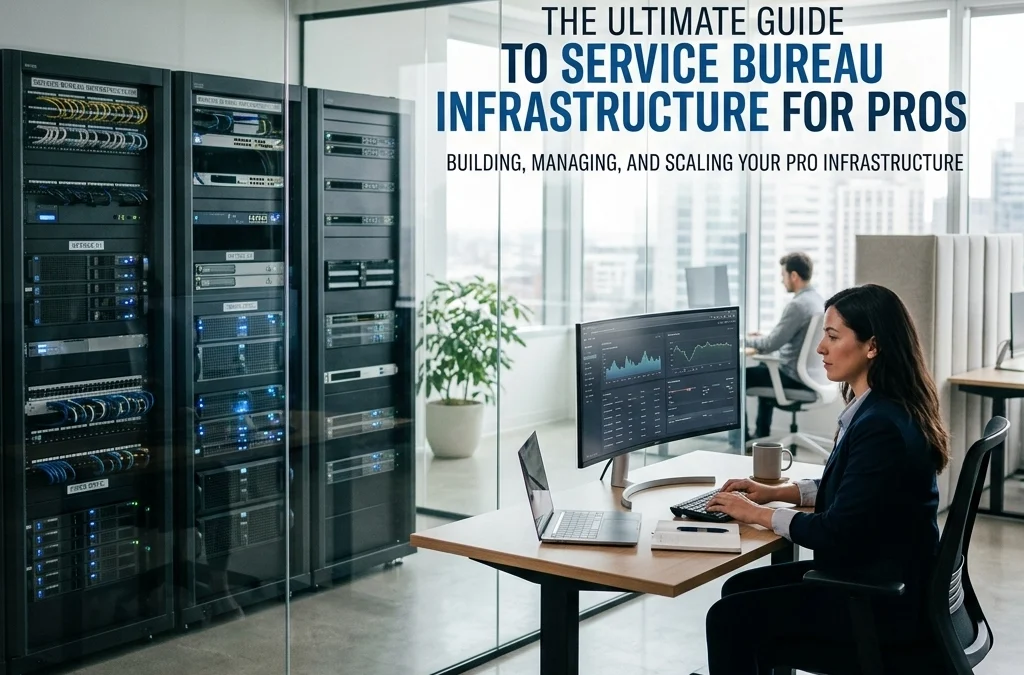
Operating a service bureau in the tax industry requires more than high-volume processing capabilities. It demands a robust, scalable infrastructure designed to support multiple Electronic Return Originators (EROs) while maintaining strict adherence to federal and state regulations. This guide outlines the essential components of a professional service bureau infrastructure.
Technical Foundation and Physical Infrastructure
The physical layer of a service bureau is the first point of failure or success. A professional environment must prioritize stability and data throughput.
Structured Cabling and Hardware
Reliable data transmission depends on high-quality cabling. Use Category 6 (Cat6) or Cat6A standards to support Gigabit speeds and minimize interference.
- Managed Switches: Deploy switches with Virtual Local Area Network (VLAN) capabilities. This allows the separation of administrative traffic from client-facing operations.
- Power Redundancy: Every server and critical networking component must be connected to an Uninterruptible Power Supply (UPS). For high-volume bureaus, a backup generator is recommended to prevent data corruption during transmission.
- Communication Racks: Equipment should be housed in secured, ventilated racks. Proper cable management reduces cooling costs and simplifies troubleshooting.
Network Connectivity
Service bureaus must maintain 99.9% uptime. This is achieved through:
- Dual-WAN Load Balancing: Utilize two different Internet Service Providers (ISPs). If one fails, the secondary connection automatically takes over.
- Quality of Service (QoS): Prioritize tax software traffic and e-file transmissions over general web browsing to ensure deadlines are met during peak filing windows.

Software Ecosystem for Service Bureaus
The software stack determines how efficiently a bureau can manage its sub-offices and EROs. The infrastructure must support multi-user environments without latency.
Professional Tax Software Selection
A service bureau requires software that offers centralized management.
- Centralized Reporting: The ability to monitor the performance, rejection rates, and bank product statuses of all EROs from a single dashboard.
- Licensing Models: Choose between solutions like Essential Tax Software for smaller operations or Unlimited Tax Software for high-volume bureaus.
Practice Management and Workflow
Managing a growing list of EROs requires automated workflows. Manual tracking leads to errors in fee splitting and compliance monitoring. Solutions found in tax practice management help automate the onboarding of new preparers and the distribution of software updates.
Data Security and Regulatory Compliance
Infrastructure must be built with the IRS Publication 4557 and the FTC Safeguards Rule as the primary blueprints.
The FTC Safeguards Rule
Service bureaus are considered "financial institutions" under the FTC Safeguards Rule. Requirements include:
- Designated Coordinator: A specific individual must oversee the security program.
- Encryption: All Data at Rest (stored on drives) and Data in Transit (during e-filing) must be encrypted using industry-standard protocols (AES-256).
- Multi-Factor Authentication (MFA): Access to any system containing taxpayer information must require MFA.
VLAN Segmentation
Isolate the service bureau’s internal database from the public-facing guest Wi-Fi or ERO training terminals. This prevents lateral movement in the event of a breach on a less-secure device.

State-Specific Infrastructure: California Requirements
As of April 5, 2026, service bureaus operating in California must align with specific state mandates.
CTEC and FTB Compliance
The California Tax Education Council (CTEC) regulates non-exempt tax preparers. A service bureau infrastructure must include a tracking system for CTEC registration numbers for all California-based EROs.
- FTB E-file Mandate: California requires most preparers who file more than 10 personal income tax returns to file electronically. Your infrastructure must support the high-speed transmission required by the Franchise Tax Board (FTB).
- Data Privacy: California Consumer Privacy Act (CCPA) standards may apply to bureaus handling large volumes of resident data. Ensure your data retention and deletion policies are automated within your storage infrastructure.
ERO Onboarding and Sub-Site Management
A service bureau's value proposition is its ability to scale other businesses. This requires a repeatable infrastructure for ERO onboarding.
EFIN vs. ERO Services
Many new preparers lack an IRS Electronic Filing Identification Number (EFIN). Your infrastructure must be able to accommodate different business models. Some bureaus provide ERO services for those without an EFIN, while others focus on supporting established EROs. Understanding the difices between ERO services and having an independent EFIN is critical for infrastructure planning.
Training and Remote Support
- Virtual Private Network (VPN): Provide EROs with a secure VPN to access the bureau’s centralized resources.
- Remote Desktop Protocol (RDP): Use secure, audited RDP sessions for troubleshooting sub-site technical issues.

Scaling the Infrastructure
As the number of EROs increases, the infrastructure must scale horizontally.
Cloud Migration
Moving from on-premise servers to cloud-based hosting provides:
- Elasticity: Scale computing power up during the January-April peak and down during the off-season.
- Disaster Recovery: Geographically redundant backups ensure that a local disaster at the bureau headquarters does not result in the loss of client data for hundreds of EROs.
Automated Fee Collection
The financial infrastructure should automate the collection of service bureau fees and the distribution of preparer fees. This minimizes manual accounting and reduces the risk of disputes.

Audit Protection and Document Storage
Bureaus must maintain rigorous record-keeping for audit defense.
Digital Document Management
Physical storage is no longer viable for high-volume bureaus. Implement a digital document management system that:
- Automatically tags documents by ERO and Tax Year.
- Provides an audit trail of who accessed or modified a file.
- Integrates directly with the tax software to reduce manual uploads.
Identity Theft Prevention
Incorporate identity theft protection protocols into the login infrastructure. This includes hardware-based security keys and IP whitelisting for ERO access.
Maintenance and Documentation
Infrastructure is only as reliable as its documentation.
Network Mapping
Maintain an updated network diagram. This is essential for compliance audits and rapid response during technical failures. Documentation should include:
- IP address schemas.
- Hardware serial numbers and warranty information.
- Contact information for ISP and software vendors.
Regular Testing
Conduct quarterly vulnerability scans and annual penetration tests. Test the restoration of backups at least twice a year to ensure that "successful" backups are actually functional.
A service bureau is a high-stakes environment where technical failure affects dozens of subordinate businesses. Building a professional infrastructure requires significant investment in hardware, software, and security protocols. By adhering to these standards, bureau owners can ensure long-term scalability and regulatory compliance.