

The IRS increased the due diligence penalty to $650 per failure for the 2026 tax year. A single return with errors across all four covered tax benefits carries a maximum penalty of $2,600. These penalties apply when preparers fail to meet specific requirements for Earned Income Tax Credit, Child Tax Credit, American Opportunity Credit, or Head of Household filing status claims.
The Four Due Diligence Requirements
Tax preparers must satisfy four distinct requirements for each applicable credit or filing status. Missing any requirement triggers the $650 penalty.
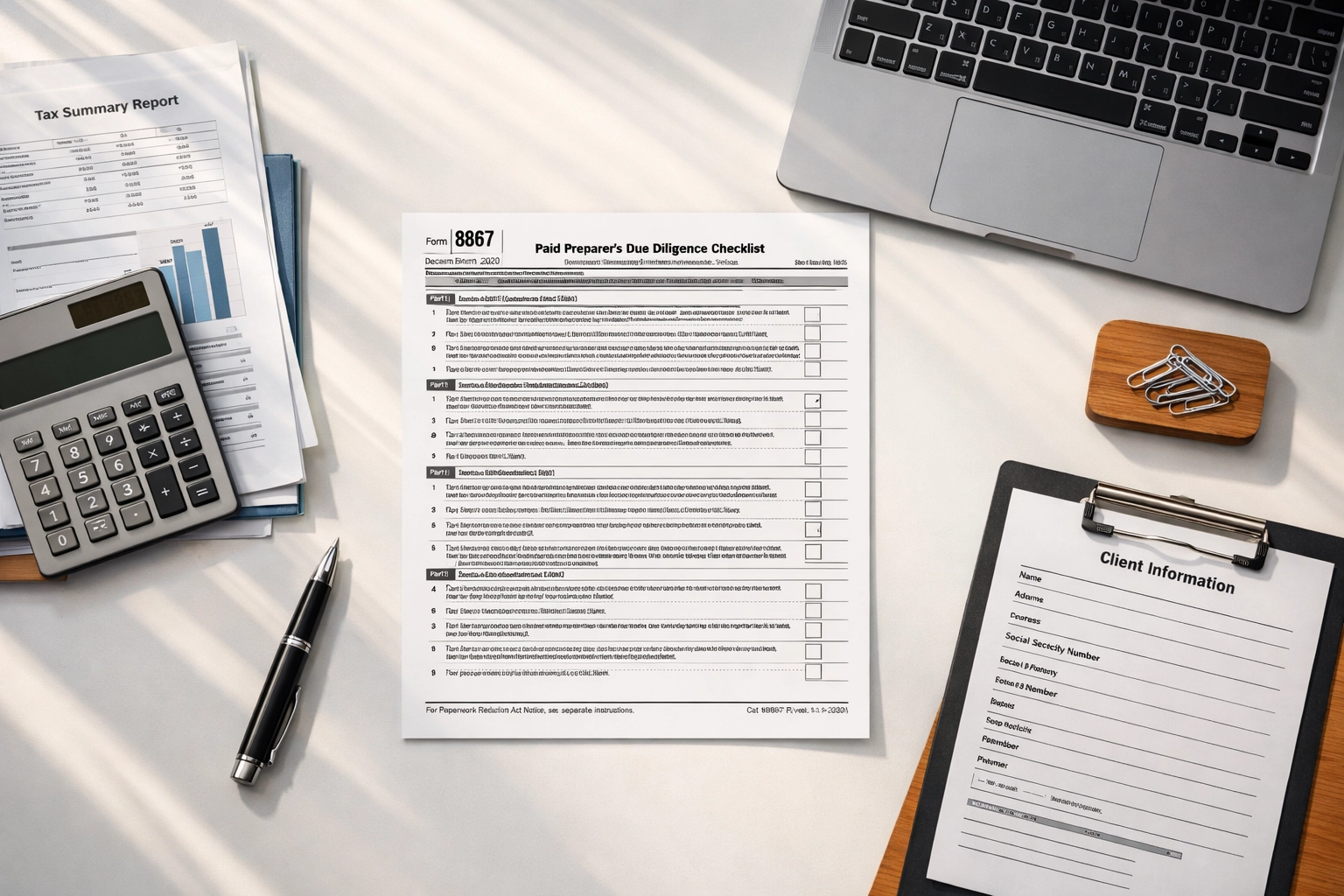
Requirement 1: Complete Form 8867
Form 8867 (Paid Preparer's Due Diligence Checklist) must be completed using information obtained directly from the client. Submit this form electronically with e-filed returns or include it with paper returns.
Common mistakes include:
- Pre-populating answers based on prior year returns
- Completing the form without client input
- Failing to submit the form with the return
- Using generic responses instead of client-specific information
Requirement 2: Compute Credits Using Required Worksheets
Complete the appropriate worksheets for each credit claimed. These worksheets appear in the Form 1040 instructions or Form 8863 instructions. Retain all computation records.
Common mistakes include:
- Skipping worksheets and relying solely on tax software calculations
- Failing to document manual calculations
- Not retaining worksheet copies
- Using incomplete or outdated worksheets
Tax software automates calculations, but preparers must still complete and retain the underlying worksheets as documentation.
Requirement 3: Conduct and Document Client Interviews
Interview clients to verify information regarding income, tax withholdings, earnings, dependents, and qualifying expenses. Document all interviews and maintain records for three years.
Common mistakes include:
- Accepting information without verification questions
- Failing to document interview responses
- Skipping interviews for returning clients
- Not asking follow-up questions when answers seem inconsistent
This requirement causes the most compliance failures. Many preparers conduct informal conversations without proper documentation. The IRS requires written records showing specific questions asked and answers received.

Requirement 4: Maintain Records for Three Years
Retain all due diligence documentation for three years from the later of the return due date or filing date. Required records include Form 8867, computation worksheets, interview documentation, and supporting client documents.
Common mistakes include:
- Deleting files after one year
- Failing to organize records by client and tax year
- Not backing up electronic documentation
- Losing paper records during office moves or system changes
The Four Covered Tax Benefits
Due diligence requirements apply when clients claim:
Head of Household Filing Status – Verify the taxpayer maintains a household for a qualifying person and meets support requirements.
Child Tax Credit and Additional Child Tax Credit – Confirm relationship, age, residency, and support tests for each qualifying child.
American Opportunity Credit – Verify enrollment status, degree program, and qualified education expenses.
Earned Income Tax Credit – Confirm earned income amounts, investment income limits, and qualifying child criteria.
Each benefit claimed on a return requires separate compliance. A return claiming all four benefits requires four separate due diligence processes.

Consequences Beyond Financial Penalties
The $650 penalty represents the minimum consequence for due diligence failures. Additional consequences include:
Referral to Office of Professional Responsibility – Repeated violations trigger investigations that can result in suspension or disbarment from practice before the IRS.
IRS Criminal Investigation – Willful failures may warrant criminal investigation, particularly in patterns suggesting intentional disregard.
Injunctions – Courts can prohibit preparers from preparing returns or operating tax businesses.
Preparer Penalties – Due diligence failures often coincide with other preparer penalties for understatement of liability or unreasonable positions.
Loss of EFIN – The IRS can revoke Electronic Filing Identification Numbers, ending a preparer's ability to e-file returns.
Protection Checklist for Tax Preparers
Use this checklist for every return claiming EITC, CTC, AOTC, or HOH status:
Before Meeting
- Review prior year return if applicable
- Prepare interview questions specific to claimed benefits
- Gather blank worksheets and Form 8867
During Client Meeting
- Ask verification questions from Form 8867
- Document all responses in writing
- Request supporting documentation
- Clarify inconsistencies before proceeding
- Complete all required worksheets
- Have client review and sign interview notes
After Meeting
- Complete Form 8867 based on documented interview
- Verify worksheet calculations
- Review all documentation for completeness
- Submit Form 8867 with return
- Save all records in organized client file
Record Retention
- Create digital and physical backups
- Label files with client name and tax year
- Set three-year retention calendar reminder
- Store records in secure, accessible location
- Verify backup integrity quarterly

Red Flags Requiring Additional Documentation
Certain situations require extra diligence:
- Self-employment income with round numbers
- Claiming maximum EITC amounts
- Schedule C expenses equal to or exceeding income
- First-time HOH filers with unclear household composition
- Students with inconsistent enrollment or expense records
- Dependents claimed by multiple preparers in prior years
- Last-minute documentation provided without supporting records
These situations do not prevent claiming credits, but they require additional verification steps and more thorough documentation.
Software Does Not Replace Due Diligence
Tax software includes due diligence features, but preparers remain responsible for compliance. Software cannot:
- Conduct client interviews
- Verify client responses
- Ask follow-up questions
- Determine information credibility
- Replace professional judgment
Software generates Form 8867 and worksheets, but preparers must complete these forms based on actual client interviews and documented verification.
Implementation Steps
Start compliance improvements immediately:
- Create interview templates for each covered tax benefit
- Develop worksheet filing system for client records
- Train staff on documentation requirements
- Update intake forms to capture verification information
- Implement quality review process before e-filing
- Establish three-year record retention protocol
- Schedule quarterly compliance audits of client files
The $650 penalty applies per failure, per return. A practice preparing 500 returns with one due diligence failure each faces $325,000 in penalties. Compliance costs less than penalties.